 Izumifinance
 LiquidBox LP NFT eligibility and reward ranges
Izumifinance LiquidBox rewards compatible LP NFTs when their pool and liquidity range meet the conditions of an active mining campaign. An LP NFT represents a particular liquidity position, so owning one does not automatically qualify its holder for every campaign. LiquidBox supports positions from Uniswap v3 and iZiSwap DL-AMM through the programs configured for them. Within a range-based campaign, overlapping price intervals can qualify, while the degree of overlap affects reward weight. Fixed Range, Dynamic Range, and One Side apply different incentive arrangements. Under Dynamic Range, mining can continue after the position leaves its trading range, provided the program remains active.
· updatedIn short: For equal asset inputs, LiquidBox’s documented Ethereum Mainnet default assigns the greatest mining weight to a position matching the rewarded interval.
LP NFTs connect trading liquidity with mining incentives
When a campaign accepts a position, LiquidBox adds mining incentives to the trading-fee income its underlying liquidity can generate. The NFT records a specific position with its own price boundaries. Campaign organizers use those boundaries to direct rewards toward liquidity serving their chosen trading interval. Projects can therefore incentivize selected liquidity without treating every position as an identical deposit. Those income streams follow different rules: traders generate pool fees, while the mining program allocates incentive tokens among qualifying participants.
Pool compatibility comes before range weighting
The target campaign must accept the position’s underlying pool on the same network before its price range becomes relevant. Matching token names alone does not establish compatibility. A mining pool’s configuration also identifies its fee tier and the position manager handling its NFTs. LiquidBox supports mining programs based on both Uniswap v3 LP NFTs and iZiSwap DL-AMM LP NFTs.
A wallet-held NFT also needs to enter the mining program through its supported staking process. An approval grants permission to use the asset; it does not by itself establish a staked position. Campaign duration remains a separate condition. A compatible position and a valid range do not extend a program’s reward period.
Must an LP NFT exactly match the reward range?
Under the documented Ethereum Mainnet default algorithm, overlapping Uniswap v3 LP NFT ranges can qualify without identical boundaries. The campaign can customize its weighting algorithm, so this rule describes that default arrangement.
A position wider than the incentivized interval contributes only its overlapping liquidity to reward allocation. Extending the position farther beyond the reward boundaries does not enlarge the rewarded interval. The broader position still follows its own trading range.
A narrower position can share the reward interval while receiving a weighting penalty. Concentrating assets into fewer ticks raises the position’s liquidity measure, but it also reduces the overlap used for incentive weighting. Greater concentration alone does not establish a larger mining allocation.
For otherwise equal asset inputs, the documented default favors aligning the position’s boundaries with the campaign’s rewarded interval.
Other qualifying positions share the campaign’s reward budget, so individual earnings also respond to the total participating liquidity.
A shared boundary without shared liquidity
Consider a hypothetical active Ethereum Mainnet campaign using the documented default overlap algorithm. Its reward interval runs from tick A to tick B, with A below B. Compare compatible NFTs from the same pool.
The first NFT spans A to B and shares B - A ticks with the reward interval. The second starts at B and ends above B. Its lower boundary meets the reward interval’s upper boundary, leaving zero overlapping ticks. Sharing that endpoint gives the second position zero range-based reward weight under this algorithm.
The first position passes the overlap test and can use the campaign’s staking process if its remaining requirements hold. The second needs a position covering an overlapping interval. Repeating approval cannot change its existing boundaries. Actual token earnings still depend on the active reward schedule and other qualifying liquidity.
Dynamic Range separates mining from active trading fees
A Dynamic Range position can continue earning mining incentives after market movement takes its liquidity outside its trading interval, while the program remains active. A Uniswap v3 liquidity position stops earning trading fees when the market price moves outside its range. Mining eligibility and fee-generating activity can therefore diverge for the same staked NFT.
The Dynamic Range model sets liquidity around the price when participation begins, using a width the project can configure. Its name does not mean the existing NFT continuously moves its boundaries with the market. The model permits redeeming and providing liquidity around the later price to restore trading participation. That choice changes the liquidity position and requires considering the continuing campaign terms. An ended mining program supplies no continuing emissions merely because the NFT remains staked.
One Side combines pool liquidity with locked tokens
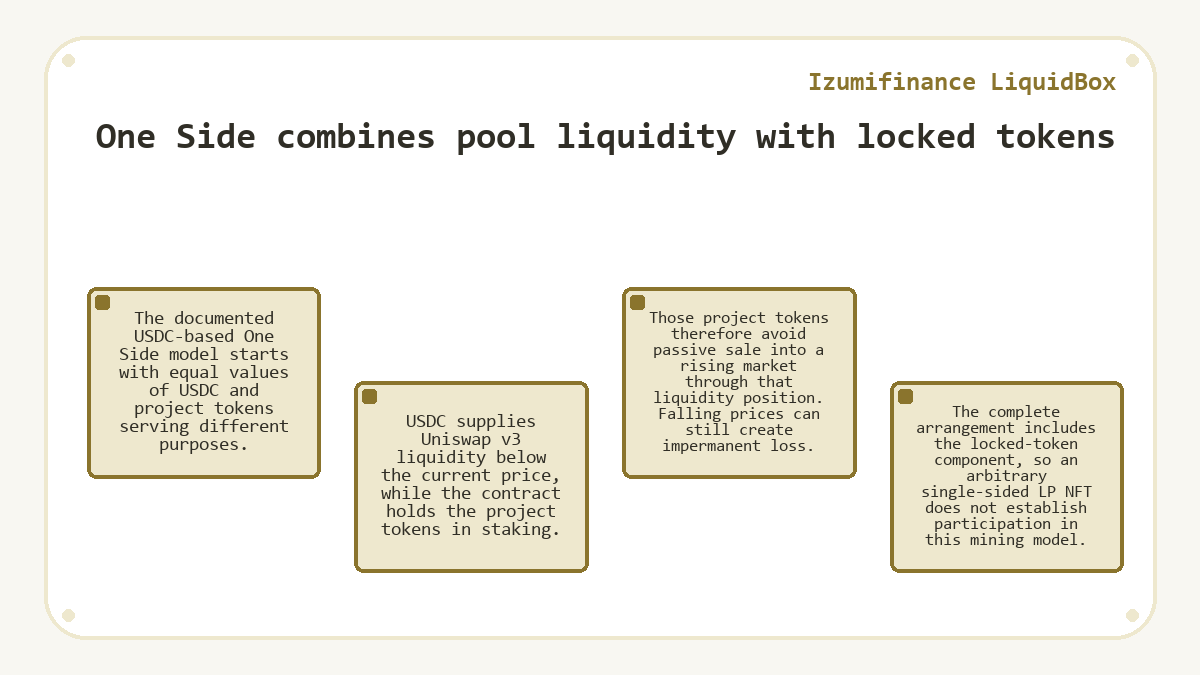
The documented USDC-based One Side model starts with equal values of USDC and project tokens serving different purposes. USDC supplies Uniswap v3 liquidity below the current price, while the contract holds the project tokens in staking. Those project tokens therefore avoid passive sale into a rising market through that liquidity position. Falling prices can still create impermanent loss. The complete arrangement includes the locked-token component, so an arbitrary single-sided LP NFT does not establish participation in this mining model.
Approval, staking, and collection affect different assets
The Fixed Range tutorial distinguishes creating the underlying liquidity position from approving and staking its resulting NFT for mining. Token approvals authorize the liquidity deposit, while NFT approval concerns the position itself. The Dynamic Range interface describes automatic staking after position creation. These interface differences matter when interpreting an NFT in a wallet: creating liquidity and participating in mining are related operations, with the selected route determining how they are combined.
Harvesting collects accrued mining rewards. It does not mean the liquidity provider has withdrawn the underlying assets from their trading pool. The Fixed Range interface distinguishes harvesting, unstaking the NFT, and withdrawing liquidity. Receiving incentive tokens does not necessarily change the position’s market exposure or end its participation in trading.
Boosting changes earning weight within campaign terms
Where a campaign supports boosting, iZi or veiZi can increase an eligible position’s earning weight under its configured mechanism. The documented veiZi model caps the boosted weight at the LP NFT’s calculated virtual liquidity. It describes a maximum boost of 2.5 times the unboosted weight, rather than a fixed multiplication of every reward payment. The required governance allocation and other participants’ weights affect the achieved boost.
A boost cannot substitute for a compatible pool or create overlapping liquidity where none exists. Before committing more assets, check whether the campaign’s reward period remains active, which incentive tokens it distributes, and whether its weighting rules justify a different position or an optional boost.
Common questions, answered
Can a Uniswap v2 LP token join an NFT-based LiquidBox campaign?
An NFT-based LiquidBox campaign uses supported liquidity-position NFTs, rather than the fungible LP tokens of Uniswap v2. A v2 pool share does not encode an individually selected price range. Holding the same underlying tokens therefore does not turn that share into a compatible v3 position.
Which networks have hosted LiquidBox’s Uniswap v3 mining programs?
LiquidBox has deployed its Uniswap v3 mining programs on Ethereum, Polygon, and Arbitrum. This deployment history does not establish an active campaign for every pair on each network. An NFT must belong to the network and pool the selected mining program accepts.
Who pays the documented LiquidBox incentive-pool setup fee?
In the documented Uniswap v3 onboarding procedure, the project arranging incentives pays the setup fee. The procedure lists $10,000 per pool, payable in iZi. This is a project onboarding charge; it does not describe a charge for every liquidity provider’s individual NFT.
When can a participant withdraw a Uniswap v3 LP NFT from LiquidBox?
The documented Uniswap v3 incentive-pool program allows NFT withdrawal during the incentive period and after reward distribution finishes. This permission concerns withdrawing the position from mining. It does not fix the token amounts obtainable when the provider subsequently removes the underlying liquidity.
What must a project choose before applying for a LiquidBox incentive pool?
A project specifies the incentivized price range, program duration, and incentive-token amount for its Uniswap v3 mining program. Those settings determine which liquidity the project wants to reward and for how long. They belong to campaign design, rather than being universal defaults for every LiquidBox pool.
Is an LP NFT’s liquidity value the same as its deposited token balance?
An LP NFT’s liquidity value measures its liquidity within the chosen range; it is not simply a token balance or a dollar amount. Range width affects how deposited assets translate into liquidity. LiquidBox can use that measure together with overlapping ticks when calculating the position’s incentive weight.
How does unstaking veiZi affect unclaimed LiquidBox farming rewards?
Unstaking veiZi can reduce unclaimed farming rewards when removing it cancels the associated boost. The veiZi withdrawal procedure requires collecting rewards before unstaking the governance NFT. This boost-related consequence concerns the earning weight applied to farming rewards; it does not change the LP NFT’s pool or price boundaries.